Quality Safe Delivery of Care is the Expectation of Every Patient
Mickey always said – ask your nurses, dialysis technicians and physicians – What kind of care would you, or your loved one, want to receive?
Is the care you are giving me, what you would want for yourself, or a loved one?
(Would you (staff) want the care you are giving me, e.g. not washing your hands?)
(Would you (staff) tell whoever was taking care of you to wash their hands if they forgot, knowing you might get an infection?)
Our latest projects
- Does Green Tea Help Detox THC? A Professional Analysis
- Does Exercise Help Detox THC: An Investigation into the Relationship between Exercise and THC Elimination
- Does Detox Work for Marijuana? A Professional’s Perspective
- How Drug Testing Reduced Medication Errors in Nursing Care
- Implementing Workplace Safety Measures in Relation to Drug Testing for Nurses
- Implementing Drug Testing in Nursing Practice
- Implementing Medical Marijuana Use in the Dialysis Care Setting
- Our Journey Implementing Drug Testing Programs in Dialysis Care Units
About Us
The comments, other than state/federal documents/information, contained herein on this website, are the opinions of Roberta Mikles, BA RN Dialysis Patient Safety Advocate. Information on this website is not to be used in lieu of medical and/or legal advice.
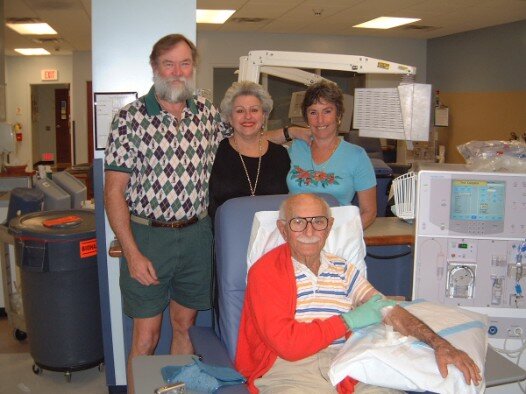
This site is dedicated to “Mickey” because he loved life, in spite of obstacles he encountered during his dialysis journey. He had courage and determination. This picture, taken several years ago, is after finishing one of his dialysis treatments. Behind him, left to right; his son-in-law, Chuck, who was more of a son to him, his daughter, Roberta, and his daughter, Suzy (Chuck’s wife).
Mickey, a well-educated dialysis patient, tried to be as involved in his care as he could, or rather as staff/physician would allow. Often asking questions, or questioning what was being done to his body (treatment-related) was not received well by some in the unit.
He received quality safe care from some staff, obviously, who deeply cared, however, from others, he received that which no patient should experience, including, but not limited, to emotional distress.
It was distressing for him when he had to remind staff to implement correct procedures (e.g. infection control), prior to inserting needles, or when removing needles. Not all staff, of course, but it seemed to be the same staff that he needed to remind. Often, behaviors exhibited by staff showed annoyance.
However, it was his body and he was implementing his own self-protection. There were times when he, and his family, wished that there was a better understanding, by those in the unit, of how important it is for the patient to be involved and fully educated, in order to work as a team to prevent errors.
Patients can prevent mistakes and often as a result of their being fully educated, they have prevented such.
He could tell, as most patients, which staff or physicians sincerely cared and which did not. Patients knew. Mickey died on Wednesday, July 14th, 2020.
It is in his name, that Advocates 4 Quality Safe Patient Care will continue to advocate for quality safe care for all dialysis patients.
Attention
Attention — DOES YOUR DIALYSIS TECHNICIAN, or NURSE NEED TO BE REPORTED? It is mandated that dialysis technicians be certified and nurses be licensed. Technicians, and nurses, should be following their facility’s procedures/policies, as well as federal and state regulations.
As noted in the surveys (inspection reports), many technicians and nurses are not doing such. If you have had a negative outcome, or a loved one has died, as the result of a technician, or nurse, not following correct practices, a complaint can be filed-(you can remain anonymous)
We recommend you visit another website where you can obtain help and support if you are experiencing difficulties in your dialysis unit.
“DialysisEthics has been on the forefront of patient advocacy and activism since 1998. From individual patient advocacy and helping dismissed patients, to US Senate hearings in 2000, and Colorado hemodialysis technician certification in 2007 DialysisEthics has always put those dealing with kidney disease first.”
To see more about DialysisEthics go to: http://www.dialysisethics2.org/
California – A sad, sad situation, what next?
CALIFORNIA CONTACT INFORMATION
For Dialysis Technicians
http://www.cdph.ca.gov/pubsforms/forms/CtrldForms/cdph318.pdf
For Nurses
Contact Info
Roberta Mikles, BA, RN
Patient Safety Advocate
ph: 858-675-1026